Gravitation
Gravitation

Table of Contents
What is Gravity?
Every object with some mass exerts the gravitational force on every other object having some mass. This force and its strength depend on the masses of the objects under consideration. Gravity helps to keep the planets to move in their orbit around the sun.
Therefore, we may say that gravity is a force that attracts a body towards the center of the earth. It is a universally accepted fact that gravity plays a major role in sustaining life on earth. This is due to the fact that the gravitational pull between the earth and the sun, the atmosphere is kept on our earth. Hence, it is the reason behind the air that we need to breathe for our survival. Not only this, but it also helps us to be at a safe distance from the sun.
What is Gravitation?
Gravitation is the force of attraction between any two bodies in the universe. In our universe, each object attracts each other with a certain amount of force. But due to the very weak nature of this force, usually, we are not able to even feel it. The large distance of separation is the main reason for its weak nature.
But, gravity’s range is considered as infinite. Its first observation was done by the famous scientist Sir Isaac Newton. He gave his very important Newton’s law of gravitation in the year 1680. Actually, this gravitation exists due to the attraction of objects with the earth.

Difference Between Gravitation and Gravity
The important difference between gravitation and gravity
| Parameter | Gravitation | Gravity |
| Nature of force | It may be an attractive force or repulsive force as well. | It is always a kind of attractive force. |
| Universal force | It is considered as the universal force. | It is not considered as the universal force. |
| Direction | The direction of this gravitational force is along the radial direction from the masses. | The direction of this force is along the line joining the earth’s center and the center of the body. It is always working towards the center of the earth. |
| Effect of force | It is a very weak kind of force. | It is a strong kind of force. |
| Vector | This force is a vector physical quantity. | Gravity force is having its own vector field. |
| Need for mass | It needs objects with two masses | It needs only one mass. |
| Zero force effect | The force will be zero when the distance between bodies is infinity. | The force of gravity will be zero at the center of the earth. |
Some more facts:
- Gravity is the weakest type of fundamental force in nature. Still, it holds together the entire solar systems and galaxies.
- The speed of free fall is consistent over the earth. This speed is computed as 9.8 meters per second
- The force of attraction between us and the Earth is nothing but our weight.
- The gravitational force on the surface of the moon is 16% of what is on the surface of the earth.
- Black Holes are having very strong gravity in the entire universe.
- Gravity has the existence with unlimited range.
- Newton’s law and Kepler’s law are the two popular laws for gravitation.
- Gravitational force does not depend on the kind of medium.

The History of Gravitation
The earliest philosophers wondered why objects naturally tend to fall toward the ground. Aristotle (384–322 BCE) believed that it was the nature of rocks to seek Earth and the nature of fire to seek the Heavens. Brahmagupta (598~665 CE) postulated that Earth was a sphere and that objects possessed a natural affinity for it, falling toward the center from wherever they were located.
The motions of the Sun, our Moon, and the planets have been studied for thousands of years as well. These motions were described with amazing
Nicolaus Copernicus (1473–1543) is generally credited as being the first to challenge Ptolemy’s geocentric (Earth-centered)
Finally, in Einstein’s
of Gravity, we look at theNewton’s Law of Universal Gravitation

s shown in Figure , the
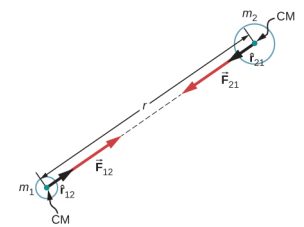
These equal but opposite forces reflect
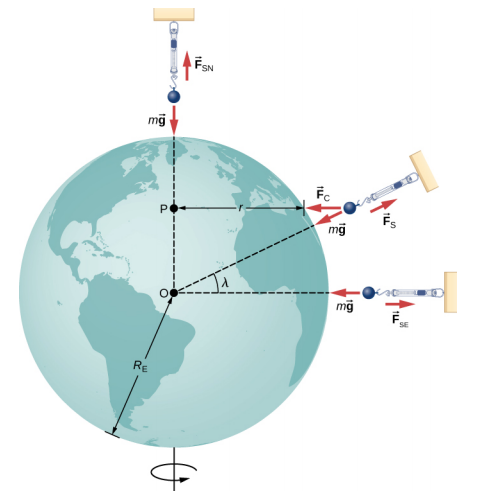
Gravitation Near Earth's Surface
As we saw in Applications of
’s Laws, objects moving at constant speed in a circle have aLet’s first consider an object of mass m located at the equator, suspended from a scale (Figure ). The scale exerts an upward
Newton’s Law of Gravitation
According to Newton’s law of gravitation, every particle in the universe attracts every other particle with a force whose magnitude is,
- Directly proportional to the product of their masses, i.e., F ∝ (M1M2) . . . . (1)
- Inversely proportional to the square of the distance between their centre, i.e., (F ∝ 1/r2) . . . . (2)
On combining equations (1) and (2), we get,
F ∝ M1M2/r2
F = G × [M1M2]/r2 . . . . (7)
Or, f(r) = GM1M2/r2 [f(r) is a variable, non-contact, and conservative force]
As f(r) varies inversely as a square of ‘r,’ it is also known as the inverse square law force. The proportionality constant (G) in the above equation is known as the gravitational constant.
The dimension formula of G is [M-1L3T-2]. Also, the value of the gravitational constant,
- In SI units: 6.67 × 10⁻¹¹ Nm2 kg-2,
- In CGS units: 6.67×10⁻⁸ dyne cm2 g-2
Vector Form of Newton’s Law of Gravitation
The vector form of Newton’s law of gravitation signifies that the gravitational forces acting between the two particles form action-reaction pair.

From the above figure, it can be seen that the two particles of masses are placed at a distance.
The direction of the vector is from M1 to M2
Therefore, the force applied on M2 by M1 is

The negative sign indicates the attractive nature of the force.
Similarly, force on M1 and M2
Hence, the applied forces are equal and opposite. Also, the gravitational force follows Newton’s third law.
Gravitational Force Formula
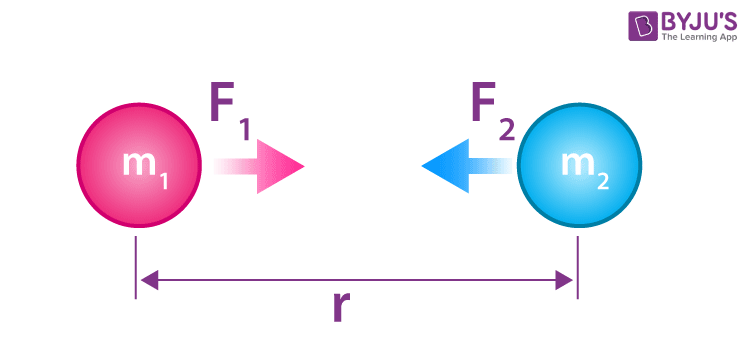
Gravitational force is explained using Newton’s law of gravitation. Gravitational force decides how much we weigh and how far a ball travels when thrown before it lands on the ground.
Also Read: Important Gravitation Formulas for JEE
According to Newton’s law of gravitation, every particle in the universe attracts every other particle with a force that is directly proportional to the product of their masses and inversely proportional to the square of the distance between them.
Mathematically, it can be represented as,
- F is the gravitational force between two objects measured in Newton (N).
- G is the universal gravitational constant with a value of 6.674 × 10⁻¹¹ Nm2kg-2.
- m1 is the mass of one massive body measured in kg.
- m2 is the mass of another massive body measured in kg.
- r is the separation between them measured in kilometre (Km).
Principle of Superposition of Gravitational Forces
Newton’s law of gravitation answers only the interaction between two particles; if the system contains ‘n’ particles, there are n(n – 1)/2 such interactions.
According to the principle of superposition, if each of these interactions acts independently and uninfluenced by the other bodies, the results can be expressed as the vector summation of these interactions:
F = F12 + F13 + F14 . . . . . . + F1n.
It states that:
“The resultant gravitational force F acting on a particle due to the number of point masses is equal to the vector sum of forces exerted by the individual masses on the given particle”.
Derivation of Newton’s law of Gravitation from Kepler’s Law
Suppose a test mass is revolving around a source mass in a nearly circular orbit of radius ‘r’ with a constant angular speed (ω). Then, the centripetal force acting on the test mass for its circular motion is,
F = mrω2 = mr × (2π/T)2
According to Kepler’s 3rd law, T2 ∝ r3
Using this in force equation, we get,
F = 4π2mr/Kr3 [Where, K = 4π2/GM]
⇒ F = GMm/r2, which is the equation of Newton’s law of gravitation.
Solved Examples
1. What is the force of gravity acting on an object of mass 2000 kg at the Earth’s surface?
Given:
Mass of Earth (m1) = 5.98 × 1024kg
Mass of object (m2) = 2000kg
The radius of the Earth (r)= 6.38 × 10⁶m
Acceleration due to gravity (g) = 9.8 m/s2
Universal constant (G) = 6.67 x 10⁻¹¹ N m2 / kg2
Solution:
F = Gm1m2/r2
F = ( 6.67 x 10⁻¹¹) (5.98 × 1024)(2 x 10³)/(6.38 × 106)2
F = (7.978 x 10¹⁷)/ (4.07044 × 10¹³)
F = 1.959 x 10⁴ or F = 19.59 N
2. What is the force of gravity acting on an object of mass 1000 kg at 20,000 meters above the Earth’s surface?
Given:
Mass of Earth (m1) = 5.98 × 1024kg
Mass of object (m2) = 1000kg
The radius of the Earth (r)= 6.38 × 10⁶m
Acceleration due to gravity (g) = 9.8 m/s2
Universal constant (G) = 6.67 x 10⁻¹¹ N m2 / kg2
h = 2 x 10⁴ m
Solution:
F = Gm1m2/(r +h)2
F = ( 6.67 x 10⁻¹¹) (5.98 × 1024)(1 x 10³)/(6.38 × 106 + 2 x 10⁴ )2
F = (3.988 x 10¹⁷)/(4.058 x 1013)
F = 9,827.50
F = 0.9827 x 10⁴
What is Gravitational Force?
According to Newton’s universal law of gravitation,

The force of attraction between any two bodies is directly proportional to the product of their masses and is inversely proportional to the square of the distance between them.
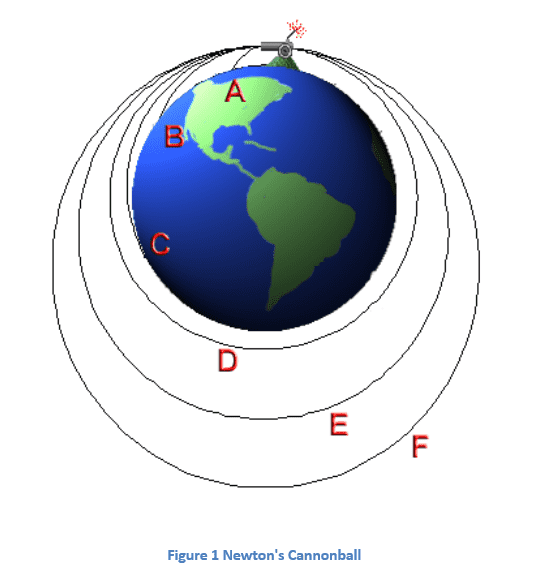
According to this thought experiment, he assumed a cannon on the top of a very high mountain peak. The following cases can arise if the cannon is loaded with gunpowder and fired.
- If the speed of the cannon is low, it falls on the Earth following a projectile motion.
- If at that particular altitude, the speed of the cannon is equal to the orbital speed, the cannonball will go on circling the Earth about a fixed orbit.
- If the speed of the cannonball is higher than the orbital velocity but is insufficient to leave the Earth, i.e. less than the escape velocity of the Earth then, the cannonball continues to revolve around Earth in an elliptical orbit.
- If the speed is equal to escape velocity or greater than that, the cannonball leaves the Earth in a parabolic or hyperbolic trajectory.

Read more: Planetary Formulas
Now, coming back to our original question, how do planets revolve around the Sun? Well, the gravity of the Sun keeps the planets around it in fixed orbits. Due to the same reason, the Moon orbits the Earth due to the gravitational pull of the Earth on the Moon. But if the Sun is attracting the Earth, why doesn’t it fall into it or why doesn’t the Moon collide with the Earth?
The reason behind this is that Earth has a velocity perpendicular to the gravitational force exerted by the Sun. Thus, the planets move sideways in addition to getting attracted by the Sun, which keeps them moving in specified orbits. Similarly, the Moon revolves around the Earth without falling into it.
References
- ^ Fritz Rohrlich (25 August 1989). From Paradox to Reality: Our Basic Concepts of the Physical World. Cambridge University Press. pp. 28–. ISBN 978-0-521-37605-1.
- ^ Klaus Mainzer (2 December 2013). Symmetries of Nature: A Handbook for Philosophy of Nature and Science. Walter de Gruyter. pp. 8–. ISBN 978-3-11-088693-1.
- ^ "Physics: Fundamental Forces and the Synthesis of Theory | Encyclopedia.com". www.encyclopedia.com.
- ^ Isaac Newton: "In [experimental] philosophy particular propositions are inferred from the phenomena and afterwards rendered general by induction": "Principia", Book 3, General Scholium, at p.392 in Volume 2 of Andrew Motte's English translation published 1729.
- ^ a b The Michell–Cavendish Experiment, Laurent Hodges
- ^ a b Hesse, Mary B. (2005). Forces and fields: the concept of action at a distance in the history of physics (Dover ed.). Mineola, N.Y: Dover Publications. ISBN 978-0-486-44240-2.
- ^ a b Feather, Norman (1959). An Introduction to the Physics of Mass Length and Time. Edinburgh University Press.
- ^ Whittaker, Edmund T. (1989). A history of the theories of aether & electricity. 1: The classical theories (Repr ed.). New York: Dover Publ. ISBN 978-0-486-26126-3.
Pingale Gitanjali Sandip
(B.ed. First Year 2023-24)
Comments
Post a Comment